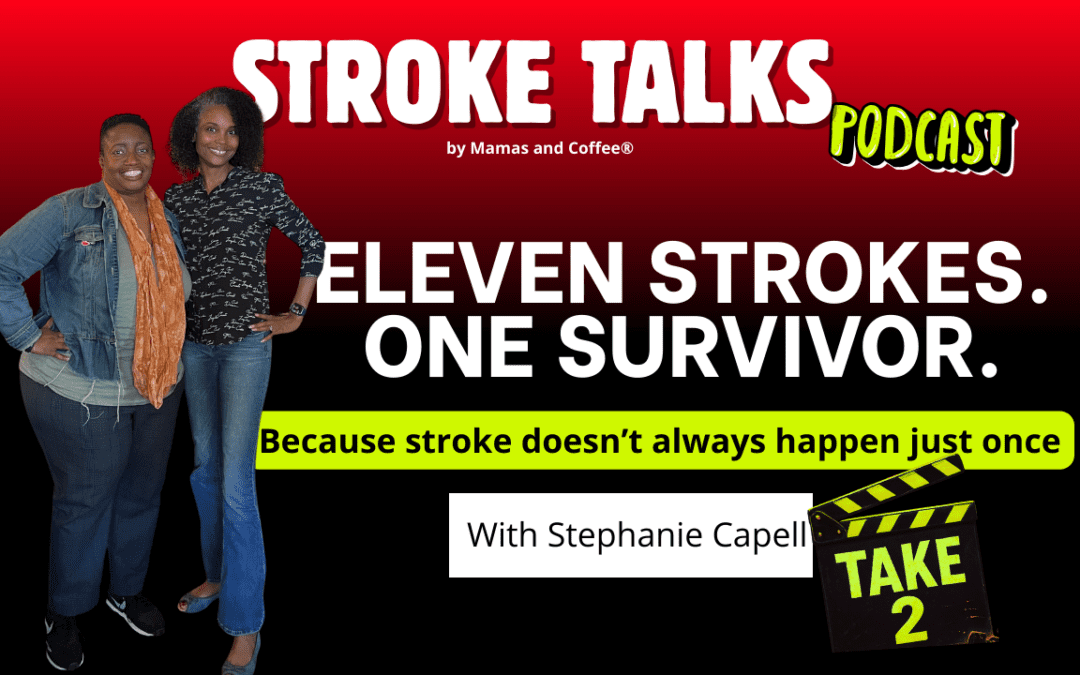
Sometimes on Stroke Talks, we laugh our way through conversations because, honestly, if we didn’t laugh, we might cry.
And sometimes we do both.
That was my conversation with Stephanie.
Stephanie is a stroke survivor who has lived through eleven strokes. Yes, eleven. And even with everything she has experienced, multiple hospitalizations, brain surgery, and a life that looks very different from it once did, she still shows up with humor, faith, and honesty.
But during our conversation, one thing kept standing out to me.
Stephanie dismissed her symptoms.
Not once.
More than once.
And if we’re being honest, a lot of us have done the same thing.
Stroke symptoms don’t always look the way people expect
When Stephanie shared about her first stroke in 2020, the warning signs didn’t look like what most people expect when they hear the word stroke.
She didn’t suddenly collapse.
She didn’t notice obvious facial drooping or slurred speech.
She didn’t experience the dramatic “movie scene” moment people often imagine.
Instead, she felt extremely tired, had no appetite, and just felt sick all week. BUT she did begin vomiting. Just as many of us would, she assumed she might have a virus or some kind of stomach bug.
That’s exactly why strokes can be so dangerous.
According to the CDC, someone in the United States has a stroke every 40 seconds, and stroke remains one of the leading causes of serious long-term disability. Many survivors later say they ignored early symptoms because they didn’t match what they thought a stroke would feel like.
Stephanie kept feeling off that entire week and figured she would probably go to the doctor soon.
But by the time she arrived at the emergency room, doctors discovered she had already suffered a stroke.
Sometimes stroke symptoms don’t shout.
Sometimes they whisper.
Trying to “sleep it off” is more common than people think
As Stephanie continued sharing her story, another pattern started to appear.
Whenever something felt off, her instinct was to go lie down and try to sleep it off.
Now, if you’re reading this and thinking, “I’ve done that,” you’re not alone.
Many people assume fatigue, dizziness, nausea, or headaches are just signs that they need rest. But stroke survivors often share that they ignored symptoms because they thought they were simply overtired or stressed.
Stephanie admitted that this happened to her more than once throughout her stroke journey.
She pushed through symptoms.
She rested instead of seeking care.
She assumed things would pass.
Unfortunately, strokes don’t wait for us to catch up.
The headache that led to brain surgery
One of the most powerful moments in our conversation came when Stephanie shared the story of the stroke that eventually led to brain surgery after a hemorrhagic stroke.
Before that stroke, she had been experiencing a headache.
Not the “worst headache of my life” type people often hear about with brain bleeds.
Just a headache that wouldn’t go away.
By this point in her journey, Stephanie was living in an assisted living facility after a previous stroke had affected her mobility. The facility allowed her to maintain independence while also having access to nurses and medical support.
So when the headache started, she mentioned it to the nurse.
But here’s the important part.
She presented it like it was a normal headache.
She was given Tylenol and life continued, but the headache stayed.
Even then, Stephanie still didn’t frame it as something severe. During our conversation, she admitted something incredibly honest: she has a lifelong habit of downplaying pain.
She shared a childhood story about breaking her arm and essentially treating it like it only needed a Band-Aid.
That moment stuck with me because it reveals something many people struggle with.
Sometimes it’s not just about whether others take our symptoms seriously. Sometimes we don’t present our symptoms seriously.
Every stroke can look different
Another important takeaway from Stephanie’s story is that no two strokes are exactly alike.
Her strokes didn’t all present the same way.
One involved extreme fatigue and nausea.
Another occurred while she was driving and left her feeling disconnected.
Another began with a persistent headache that eventually led to a hemorrhagic stroke and brain surgery.
According to the American Stroke Association, stroke symptoms can vary widely depending on which part of the brain is affected. That’s why the BE FAST stroke recognition method is often used to identify warning signs:
- Balance problems
- Eyesight changes
- Face drooping
- Arm weakness
- Speech difficulty
- Time to call emergency services
You can read more about common warning signs in this Stroke Talks article:
👉 [What Are the Early Warning Signs of Stroke?]
But even with these guidelines, many strokes don’t follow a perfect checklist.
Stephanie’s story is proof of that.
Stroke recovery isn’t only physical
One of the things Stephanie and I connected on deeply was the fatigue that comes after a stroke.
And not the kind of tired that disappears after a quick nap.
Stephanie described how something as simple as driving around the block could leave her completely drained.
Not sleepy.
Drained.
Stroke survivors often describe this type of exhaustion as post-stroke fatigue, which affects nearly 50–70% of survivors according to stroke research.
It’s not just about the body healing.
The brain is healing too.
Even everyday activities like conversation, driving, or grocery shopping can take enormous mental energy.
Because recovery isn’t only physical.
It’s emotional.
It’s spiritual.
Advocating for yourself matters
If there’s one lesson Stephanie’s story teaches, it’s this:
- Don’t minimize your symptoms.
- Say what you’re experiencing clearly.
- Don’t soften it.
- Don’t brush it off.
- Don’t assume it’s nothing.
Stephanie said something powerful during our conversation that stuck with me.
Let the medical professionals determine what’s wrong but make sure you fully explain what’s happening.
Your voice matters.
Your symptoms matter.
And sometimes speaking up clearly can save your life.
Choosing joy after stroke
Despite everything Stephanie has endured, she ended our conversation with a message that stayed with me.
Choose joy.
Not fake joy. Not pretending things are easy, but choosing joy even while walking through a difficult journey.
Choosing laughter when possible.
Choosing faith.
Choosing to keep going.
Stephanie’s story is a reminder that life after stroke is complicated, messy, emotional, and sometimes exhausting.
But it’s still life.
And every story shared through Stroke Talks helps someone else feel less alone — and maybe even recognize the signs sooner.
Connect with the Stroke Talks community
If you are a stroke survivor, caregiver, or family member, you are not alone.
Stroke Talks is a space where we share real stories, real struggles, and real recovery journeys.
You can:
- Read more survivor stories in the Stroke Talks category on our blog
- Join upcoming virtual support conversations
- Or share your own story
👉 Visit StrokeTalks.com to learn more and connect.
Because sometimes the most powerful thing a survivor can do…is simply tell their stroke story.

 Do you want to join a fun, supportive group of women? Come on over to our supportive, loving and fun facebook group. Mamas and Coffee® is all about the REAL of womanhood. Join Us.

Know You Be You Love You® message to empower others in life.
- Are We Raising Kids Who Can Handle the Real World? - September 26, 2026
- Sickle Cell Disease and Stroke in Children: What Parents Should Know - September 8, 2026
- A Stroke at Nine Years Old: Chloe’s Story of Survival, Growing Up and Finding Her Voice - August 27, 2026